Exhibition 'URBAN ART BIENNALE 2026' in World Heritage Site Völklinger Hütte
The URBAN ART BIENNALE is one of the world’s largest exhibitions of this anarchic art form, which transcends conventional ‘white cube’ aesthetics. Since 2011, every two years, the entire site of the Völklinger Hütte enters into dialog with this art form that has evolved from street art and graffiti.
Since the last two biennials extended far into the urban landscape of Völklingen, the 2026 edition will once again place a stronger emphasis on the location and contents of the Völklinger Hütte. More works than ever before are being created in situ, specifically for their location within the World Heritage Site. Numerous artists are engaging directly through their work with the architecture and history of the former ironworks.
‘Street art and graffiti have developed in tension with the city, competing with its existing messages. Equally today’s urban art needs both a counterpart and a partner: a place whose spatial structure can serve as a source of inspiration or a point of distinction, and whose history the artist’s work can engage with. The Völklinger Hütte offers countless possibilities for this’, says the curator of the URBAN ART BIENNALE, Frank Krämer.
The rugged charm of the burden shed or the sintering plant will meet delicate fabrics and expansive installations. NeSpoon weaves a delicate spider’s web of crocheted doilies between the sintering plant and the burden shed, whilst graffiti pioneer Boris Tellegen – known as DELTA and for his three-dimensional-looking letters – translates his spatiality into a gigantic two-tone wooden sculpture.
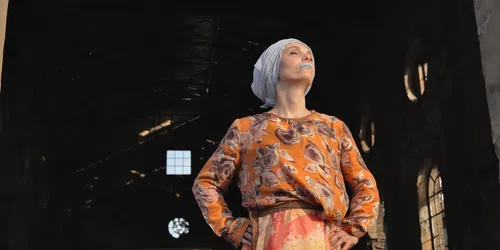
In Baptiste Debombourg’s truly multifaceted installation about the work and workers of the Völklinger Hütte, clothes studded with shards of mirror glass play a central role. The French artist Milo collects fingerprints in Völklingen and transfers them onto paper using coal dust in order to bring them to the burden shed of the World Heritage Site. Igor Ponosov translates the distinctive movements of ironworkers into a performance that brings new life to the historic rhythm of the industrial site. Through the jackets, shirts, trousers, skirts, scarves, and caps that Coco Bergholm designed, which are inspired by the different surfaces of the former ironworks and today’s World Heritage site, ranging in colour from rust red to paradise green, visitors can quite literally blend into the locations of the ironworks in a ‘post-industrial camouflage’. In other words: HUETTECOUTURE!
The fascination with railway carriages — which were at the heart of graffiti culture and served as the main means of transportation at the Völklinger Ironworks — is brought to life at this year’s URBAN ART BIENNALE through art installations and a photographic exhibition that reflects the culture of urban graffiti crews and allows visitors to experience street art in remote and inaccessible locations.
REFRESHINK draws on a traditional artistic technique to create spray-painted works reminiscent of mosaics. In contrast, Tomas Lacque allows his urban installation to solidify beneath a layer of paint, creating the impression that a shower of ash has fallen onto it. This evokes associations with Pompeii following the volcanic eruption.
The artist Ampparito chose the roof of the Burden Shed as the canvas for his message. The large letters of his work are best viewed from the World Heritage Site's viewing platform, which is 45 metres above the ground. It plays on the messages that car owners in Spain sometimes place inside their vehicles: NO HAY NADA DE VALOR, loosely translated to ‘There’s nothing of value in here’. As if!