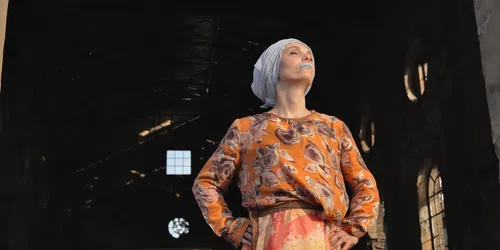
Exhibition 'X-RAY - The Power of Roentgen Vision' in World Heritage Site Völklinger Hütte
X-RAY is the first exhibition ever to comprehensively dedicate itself to the phenomenon of X-rays and the numerous cultural and artistic aspects of the X-ray vision. Based on the wide spectrum of X-ray technology – from the very first X-ray image to historic X-ray devices in medicine and the natural sciences, and up to the latest X-ray satellite in space research – the exhibition particularly highlights the creative interplay of the X-ray gaze in art and cultural history, politics, nature, literature and architecture, music, fashion, and cinema.
On November 8, 2025, it will be exactly 130 years since Wilhelm Conrad Röntgen first consciously perceived X-rays in his Würzburg laboratory as a previously unknown phenomenon. Only a few weeks later, this groundbreaking discovery spread like wildfire around the globe, inspiring not only scientists but also visual artists, musicians, filmmakers, and cartoonists.
This fascination remains unbroken to this day, as demonstrated by the X-RAY experience parcours: In the industrial cathedral of the Blower Hall, it unites an X-ray chapel by Wim Delvoye as well as a transparent brick labyrinth by Cris Bierrenbach, a catwalk featuring X-ray fashion, and a cinema for X-RAY films. Across 18 chapters, a striking panorama of modernity and the present unfolds: Here, Marie Curie encounters Claude Cahun, Frida Kahlo, Isa Genzken, and Iris van Herpen; John Heartfield meets Edvard Munch, Mies van der Rohe, Thomas Mann, and William Wegman. X-RAY makes the invisible visible – turning art and science into a tangible experience.
“X-rays permeate our modernity and present in an utterly unique way: Thanks to them we experience medicine, politics, history, art, and nature differently – even concepts like gender roles are redefined. We literally glimpse at otherwise hidden layers of ourselves and our environment – from the molecules and codes of our bodies, to the most distant galaxies of outer space,” says curator Dr. Ralf Beil.
HISTORY AND PRESENT OF X-RAYS
Following Wilhelm Conrad Röntgen’s discovery of X-rays in November 1895, news of this novel type of radiation and its ability to penetrate the invisible realm spread like wildfire, unleashing a storm of enthusiasm among physicists, doctors and the general public. After his discovery on 8 November 1895, Wilhelm Conrad Röntgen sent off special prints in five languages with a detailed description of his experimental setup, so that countless laboratories with the same equipment, from Buenos Aires to Vienna, St. Petersburg, Calcutta and Melbourne, were able to repeat the production of the rays and images of X-rayed objects. Yet he relinquished any claim to patent rights, a decision that fuelled the spread of this seemingly magical form of radiation – and surely played a role in him being awarded in 1901 the first ever Nobel Prize in Physics.
The discovery of X-rays is the spectacular culmination of a quest to discover the realm of the invisible in the late 19th century. Speculative forays over preceding decades indicate a widespread fascination with this topic. A story by Kurd Laßwitz, for example, the father of German science fiction, tells of a private researcher who develops a substance called “Diaphot” that renders the body transparent. Similarly, the novel Elektra, published by Ludwig Hopf in 1892 under the pseudonym of Philander, features a country doctor and his celebrated wish: “If only there were a way to make people as transparent as jellyfish!”
It was in 1895, the year of Röntgen’s discovery, that Sigmund Freud coined the word “psychoanalysis” to describe the method by which he would plumb the realm of dreams and the unconscious. That same year, the first ever commercial film was screened in Berlin using the Bioscope format. Soon after, G. A. Smith’s short film The X-Rays (1897) made playful use of this magical form of radiation in a story of two lovers. Around the same time, microbiology discovered a hitherto unknown “life form”: the virus. From the very beginning, Eros, Thanatos, and Techne (Ancient Greek for art, skill, craft) were all inextricably linked with X-ray vision.
X-RAY showcases a broad spectrum of X-ray technologies and its many applications, including early laboratory apparatus and X-ray images, the Pedoscope shoe-fitting machine (introduced around 1920), and X-ray satellites such as eROSITA, which are used to explore galaxies and investigate dark matter in space.
The central theme of the exhibition is the transillumination – whether close-up or from afar – of animate and inanimate matter. Exhibits include the “Transparent Human”, which was created at the end of the 1920s by the Deutsches Hygiene-Museum in Dresden. This iconic representation of X-ray vision provides a view of the complex structures within the human body.
The imaging techniques of X-ray technology have continuously improved – culminating in computed tomography (CT), which allows the generation of three-dimensional data. During examinations, radiation exposure, which used to be massive and hazardous to health, is now kept as low as possible. While radiology has become an ever-evolving routine, cultural actors remain fascinated by the phenomenon of X-rays in various ways up to the present day.
The creative means employed in such works include original X-ray images, which are cropped, painted over, or modified, augmented and collaged with different materials and colours; digitally enlarged images that serve as templates for glass windows; and graphic simulations of the X-ray process. Similarly, radiological motifs are incorporated in paintings, sculptures and graphics. And skull X-rays feature as a motif in the vanitas genre along with skeletons and individual bones, both continuing in idiosyncratic fashion a long tradition of memento mori and danse macabre.
Used as a medium in the visual arts, X-ray images depart from a traditional, mimetic, realistic reproduction of reality. Instead, they deal in alienation, depriving their object of its three-dimensional spatiality, replacing it with a shadowy silhouette, and adding metaphorical depth by revealing hidden structures and the invisible. This medium, developed at the threshold of the 20th century, has therefore become a hallmark of both modern and contemporary art.
When artists begin, starting with Meret Oppenheim, to present skull X-rays as self-portrait, the renunciation of the familiar human image is complete. Beneath the surface, an entirely different individual (or precisely beyond-individual) identity reveals itself. Beyond the visual arts, a radiological aesthetic has left its impact on architecture, fashion, advertising, caricature and comics.
X-ray images and the associated X-ray gaze appear as citations permeating life and everyday routines in literature and sometimes even become agents of action in film and television.