
The world's greatest maritime museums preserve centuries of seafaring adventure, from Viking longships to nuclear submarines, offering visitors the chance to walk the decks of legendary vessels.
The ocean has shaped human history like no other force, driving exploration, trade, warfare, and innovation across millennia. Maritime museums serve as gateways to this vast heritage, housing everything from ancient navigation instruments to massive warships that once ruled the waves.
These institutions go beyond static displays, offering immersive experiences aboard historic vessels, interactive exhibits on naval engineering, and collections that span from Age of Sail navigation charts to modern oceanographic research. Here are ten premier maritime museums that bring the sea's captivating history to life.
1. Vasa Museum
Built around a 17th-century warship that sank on its maiden voyage in 1628 and was salvaged 333 years later, this museum offers an unparalleled glimpse into naval architecture and life at sea during Sweden's imperial age.
The ship itself is 95% original, preserved in the cold Baltic waters, with intricate wooden sculptures still intact. Nine separate exhibitions explore everything from the ship's construction to the archaeological recovery process, while visitors can view the vessel from multiple levels, revealing the impressive scale of this 64-gun warship that never made it past Stockholm harbor.

2. National Maritime Museum
As the largest maritime museum in the world, this Greenwich institution chronicles Britain's naval dominance across four centuries. The collection includes over two million items, from Nelson's blood-stained Trafalgar uniform to intricate ship models and navigation instruments that guided explorers to distant continents.
The museum's galleries trace the evolution of naval warfare, the impact of trade and empire, and the human stories of sailors, explorers, and passengers. Interactive displays allow visitors to fire a cannon, navigate by the stars, and understand how maritime power shaped global history.
3. Mystic Seaport Museum
This living history museum recreates a 19th-century coastal village while preserving over 500 historic vessels, including the Charles W. Morgan, America's last wooden whaling ship from 1841.
Visitors can climb aboard tall ships, watch shipwrights use traditional techniques, and explore the vital role New England played in maritime commerce and whaling. The museum's planetarium demonstrates celestial navigation methods, while authentic buildings house collections of scrimshaw, figureheads, and maritime art. The working preservation shipyard offers rare insight into how historic vessels are maintained for future generations.

4. National Maritime Museum
Housed in a grand 17th-century naval storehouse, this museum celebrates the Dutch Golden Age when Amsterdam was the world's most important port. The star attraction is a full-scale replica of the Amsterdam, an 18th-century East Indiaman ship moored outside, where costumed interpreters bring maritime life to reality.
Inside, the collection spans 500 years of seafaring history, including exquisite ship models, navigation tools, paintings by Dutch masters, and exhibits on the Dutch East India Company's global trade network. The interactive displays engage younger visitors while the historical depth satisfies serious maritime enthusiasts.

5. Australian National Maritime Museum
Positioned on Sydney's Darling Harbour, this museum tells Australia's maritime story through the lens of a nation defined by the sea. The fleet of historic vessels berthed outside includes HMAS Vampire, a destroyer that served in World War II and Vietnam, and Onslow, a Cold War submarine visitors can explore.
Inside galleries examine Indigenous watercraft, European exploration, immigration by sea, naval warfare, surfing culture, and maritime commerce. The museum uniquely captures how an island continent's identity is inseparable from the ocean, with artifacts ranging from pearling equipment to America's Cup yachts.

6. National Museum of the Royal Navy
This historic dockyard houses HMS Victory, Nelson's flagship at Trafalgar, and HMS Warrior, Britain's first iron-hulled warship, allowing visitors to walk the decks where naval history was made. The museum complex also features the Mary Rose, Henry VIII's warship raised from the seabed in 1982.
The exhibitions span from Tudor times to modern naval operations, with personal artifacts recovered from the Mary Rose providing intimate details of 16th-century maritime life. The National Museum of the Royal Navy offers an unmatched collection of historic warships in their original naval setting, where British sea power was forged.

7. Fram Museum
Built around the Fram, the world's strongest wooden ship that carried Norwegian explorers Nansen and Amundsen on polar expeditions, this museum celebrates the heroic age of Arctic and Antarctic exploration.
Visitors can board the actual vessel and descend into cramped quarters where crews endured years trapped in polar ice. The museum also houses the Gjøa, the first ship to navigate the Northwest Passage, alongside exhibits on polar wildlife, survival techniques, and the modern science conducted in Earth's extreme regions. The focus on human endurance in the planet's harshest environments makes this collection uniquely compelling.

8. Maritime Museum of the Atlantic
Halifax's strategic location on the North Atlantic gives this museum a unique perspective on maritime disasters, naval warfare, and the Age of Sail. The Titanic collection is the finest anywhere, featuring original deck chairs, woodwork, and personal effects recovered by Halifax ships that retrieved victims.
The museum also preserves the legacy of the 1917 Halifax Explosion, when a munitions ship collision created the largest man-made blast before Hiroshima. Exhibits on shipbuilding, the Battle of the Atlantic, and life aboard small fishing vessels round out a collection that captures the Atlantic's beauty and danger.

9. German Maritime Museum
This research museum combines scholarly rigor with engaging displays on 3,000 years of seafaring, from ancient trading vessels to modern container shipping. The outdoor harbor features historic ships including a 1960s deep-sea trawler and a WWII submarine visitors can tour.
The indoor galleries explore maritime technology, navigation science, fishing industries, and Germany's complicated naval history through both world wars. The museum's research institute actively studies shipwreck archaeology and maritime heritage preservation, bringing cutting-edge findings to public exhibitions. The approach balances accessibility with academic depth, making complex maritime subjects engaging for all audiences.

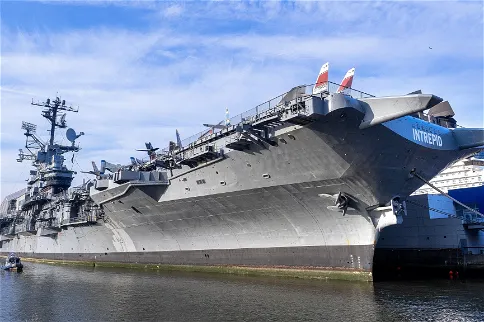
10. Intrepid Sea, Air & Space Museum
The aircraft carrier USS Intrepid, which survived kamikaze attacks and torpedo strikes during WWII, serves as the centerpiece of this floating museum on Manhattan's Hudson River. Visitors explore the massive ship's hangar deck, flight deck, and crew quarters while learning about naval aviation history.
The museum complex also includes the guided-missile submarine USS Growler and the Space Shuttle Enterprise. The focus on 20th-century naval power and its evolution from WWII through the Cold War offers perspectives on how maritime warfare transformed with aviation and nuclear technology. Standing on the deck of this battle-tested carrier provides visceral connection to naval history.
From Swedish warships frozen in time to nuclear submarines docked in modern harbors, these maritime museums preserve humanity's complex relationship with the ocean. Each institution offers something distinct, whether it's touching artifacts from polar expeditions, boarding vessels that fought in history's greatest naval battles, or understanding how maritime trade shaped civilizations.
Together, they remind us that the sea has always been both highway and barrier, source of prosperity and site of tragedy, beckoning explorers while humbling even the mightiest navies.


